In a clock, every cog and wheel operates in harmony to keep time. Similarly, in healthcare, there exists a dynamic yet often unseen force driving excellence and innovation – Quality Improvement (QI) programs. These initiatives, though not always visible to the patient’s eye, are the silent heroes in hospitals, tirelessly working behind the scenes to revolutionize patient care and operational efficiency through healthcare strategic plans.

In this blog, we’ll showcase 8 extraordinary examples from leading healthcare organizations across the US and Canada. These are the stories of strategic planning turned into action, of subtle changes yielding monumental results, and of the relentless pursuit of excellence in healthcare.
Let’s analyze how these hospitals are shaping the future of healthcare, one improvement at a time.
What is a Healthcare Quality Improvement (QI) Program?
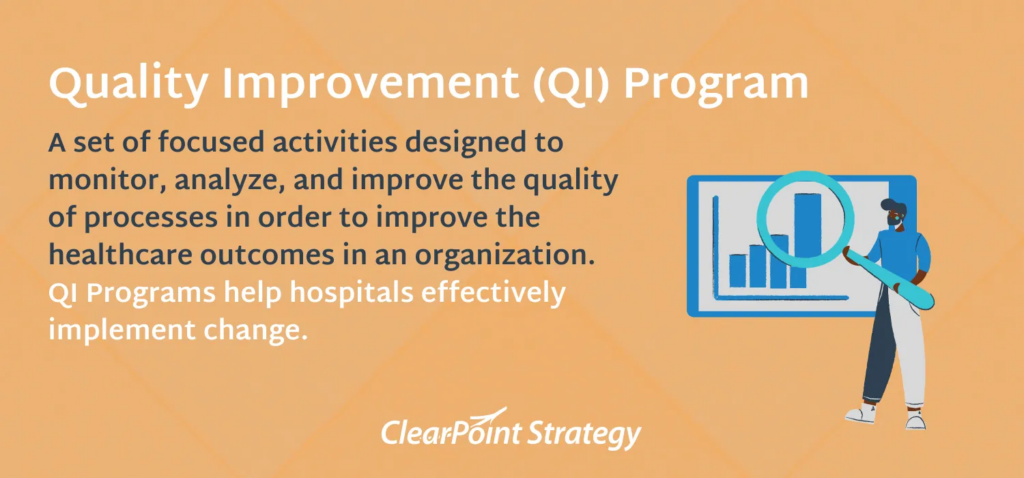
A Healthcare Quality Improvement (QI) program is a set of focused activities designed to monitor, analyze, and improve the quality of processes to improve the healthcare outcomes in an organization. By gathering and analyzing data in key areas, a hospital can effectively implement change.
Many programs are organization-wide, ongoing, and long-term (as you’ll see in some of the quality improvement examples later in this article). Concerned specifically with a hospital’s more cyclical activities, such programs aim to continually increase levels of performance (e.g. improving patient safety or lowering patient mortality).
It’s important to note that quality improvement programs are distinct from process-specific quality improvement projects, which are designed to address and intervene on a specific issue. While both are crucial, QI projects are the rapid response teams of healthcare, zeroing in on specific issues with a shorter-term focus. Together, they form a formidable force, driving forward the landscape of healthcare quality.
Why Are Quality Improvement (QI) Programs Important for Healthcare?
Quality improvement programs are critical because they drive:
- Improved outcomes for patients
- Improved efficiency of staff
- Less waste due to process failures
With lives at stake and specific standards that must be met, hospitals are held more accountable for excellence than your typical organization. Now more than ever, government and insurance reimbursements for patient care are based on health outcomes rather than procedures undertaken.
8 Examples Of Quality Improvement Initiatives In Healthcare & Hospitals
In this section, we provide 8 examples of healthcare quality improvement initiatives, each specifically tailored to programmatic approaches. They represent ongoing, long-term, and proactive endeavors that are deeply embedded across the organizational spectrum.
Remember, these programs are ongoing, long-term, and proactive initiatives that span the organization) These hospitals have different focuses and priorities, but their QI programs reflect the overarching goal of improving the quality of care (encompassing patient experience, safety, and hygiene).
Organization-Wide, Ongoing Programs
1. Florida Department of Health
The Florida Department of Health devised its current statewide improvement plan after conducting a health assessment across all 67 counties to identify important health issues that impact Floridians. The 2022-2026 plan identifies seven priority areas, each of which includes up to four goals and three objectives:
- Alzheimer’s Disease and Related Dementias
- Mental Wellbeing and Substance Abuse Prevention
- Chronic Diseases and Conditions
- Transmissible and Emerging Diseases
- Injury, Safety and Violence
- Maternal and Child Health
- Social and Economic Conditions Impacting Health
The department tracks its progress using ClearPoint and provides quarterly updates on objective status, activity progress, and key accomplishments to priority area workgroup members.
2. Joseph Brant Hospital (JBH)
JBH’s 2021/2022 quality improvement plan comprises nine indicators the hospital identified as critical areas of importance. The indicators align with JBH’s strategic plan and accreditation requirements. Targeting issues such as patient treatment and transition plans and medication reconciliation at discharge, these quality initiative examples are very different from SHSC, but still focused on improving care overall.

3. L.A. Care Health Plan
L.A. Care Health Plan’s mission is to provide access to quality health care for Los Angeles County’s vulnerable and low-income communities and residents. Its 2022-2024 Quality Improvement Program serves as a way to systematically monitor and evaluate the equity, quality, and safety of care delivered to its members. The program identifies four areas of strategic direction (an example of which is shown below); each includes multiple goals and objectives. To track performance and identify opportunities for improvement, the L.A. Care QI team continuously collects and analyzes data and plans interventions as needed.

4. Blue Care Network of Michigan
Blue Care Network Of Michigan’s quality improvement plan was developed to help realize its mission of providing members with affordable, innovative products that improve their care and health. The 2022 program focuses specifically on quality of service, clinical quality, member satisfaction and safety, pharmacy, and diversity and inclusion. Numerous committees oversee different program activities, and the effectiveness of the program as a whole is evaluated yearly.
Process-Specific Projects
In comparison to the programs above, the following are examples of quality improvement projects in hospitals and other healthcare facilities. QI projects are reactive and more focused on intervention.
5. Beth Israel Medical Center
After a series of news stories revealed medical errors and poor quality healthcare at Beth Israel, the hospital embarked on a quality improvement program to address the issues. This was a targeted intervention aimed at changing processes and the leadership structure to improve patient care.
The QI project included creating a board-level commission, establishing a best-practices group, replacing critical leaders, and introducing new clinical guidelines and policies to improve safety, communication, and transparency.
The outcomes were nothing but positive. Beth Israel was able to reduce readmissions, lengths of stay, incidents of deep vein thrombosis, infections, and complications, as well as patient mortality rates. Beth Israel is an excellent example of how tangible changes can result from a QI project.
6. Mount Sinai
Mount Sinai’s “Lose the Tube” project focused on improving metrics around one specific medical device: catheters. The hospital had realized that catheters were being given to patients who didn’t need them, and that they were being left in too long. The QI project was aimed at decreasing the number of catheter-associated urinary tract infections (CAUTI) in the hospital.
Over five months, a new system of nursing documentation and physician orders was implemented that ensured patients in need of catheters were appropriately cared for. The project successfully reduced CAUTI rates from 2.67/month to .2/month.
Something as simple as more regular and systematic check-ins was able to dramatically reduce infection for Mount Sinai.
7. UC San Diego Health
UC San Diego’s QI project was based on improving hospital discharges. This project was undertaken simultaneously with the hospital’s efforts to improve medication reconciliation processes.
UC San Diego was able to improve the quality and consistency of discharge instructions. Results also showed better communication with the patient’s support network to ensure the transition of care went smoothly after they left the hospital.
8. DaVita Dialysis Clinics (Poland)
To ensure equitable access to kidney transplantation, DaVita dialysis clinics in Poland implemented a quality improvement project to improve the referral process. Too many patients were missing their chance to receive a transplant due to calls coming in during the dialysis clinics’ off hours.
Procedural changes included the creation of transplant folders for all wait-listed hemodialysis patients and a set of clear instructions on what to tell transplant coordinators calling during off hours. This process improvement made it possible for 68 additional patients to get a transplant—people who would not normally have received one simply because of the timing of the call.
How to Get Started With A Healthcare Quality Improvement Program
Healthcare Quality improvement (QI) isn’t something you can just pay lip service to. For these programs to work, you need to embed the importance of quality into your facility’s culture from the start. Create processes and procedures that support your QI efforts—that may mean establishing dedicated QI teams, holding regular QI meetings, and making your reporting of QI efforts open and transparent.
If you’re considering implementing a quality improvement program, think about the following before you begin:
1. Determine and prioritize potential areas for improvement
You need to identify and understand how your practice could improve. Set targets aimed at making improvements in these four categories:
- Safety
- Effectiveness
- Access
- Patient-Centeredness
Examine your patient population and your facility’s operations. You may uncover barriers to care or frequently diagnosed chronic conditions, for example, or management issues such as long patient wait times.
But also make sure the initiatives you undertake are the right ones for your organization, and that they will advance you toward achieving your vision. Clearly identify how each QI priority aligns with the organization’s vision and strategic plan so everyone understands how their efforts tie to the high-level strategy.
2. Determine how to test and evaluate new ideas
What people, processes, and tools will you have in place to support potential changes? Some organizations use existing management structures to oversee QI processes, while others create new committees to coordinate and evaluate quality improvement projects. Whatever you decide to do, committee members should represent all key players involved in the issue to be effective.
You’ll also need a way to track and report on your efforts. Having a strategic management system like ClearPoint allows you to align your QI initiatives to strategy, set up priority areas and goals, and measure the important metrics and resulting changes. You’ll have everything you need to take action and continually improve quality.
3. Determine how you will communicate your results
Your quality improvement efforts should be transparent to your staff, physicians, and even patients. Include a broad range of staff members in the planning and implementation of quality improvement projects, and make the results available to everyone (patients included).
In ClearPoint, you can create a variety of easily accessible dashboards that reflect important quality improvement metrics, showing performance at a glance. When a quality initiative is successful, celebrate and acknowledge it. When things aren’t working, you can quickly adjust your actions or goals to get back on track.
4. Leverage quality improvement tools and software
Embracing appropriate software technology is key to elevating your Quality Improvement (QI) programs. Advanced tools streamline data management and analysis, which is essential for spotting trends and guiding decisions. They also automate processes, cutting down on errors and freeing healthcare professionals to focus on strategic QI initiatives. Effective communication and alignment with QI goals are also further facilitated by these tools.
Selecting software that meets your specific QI needs, such as data analytics or project management tools, is crucial. Equally important is training your team for effective use and regularly assessing the software’s impact on your QI goals, while ensuring compliance with healthcare regulations and data security.
ClearPoint Strategy enhances healthcare QI programs with a comprehensive platform tailored to the evolving healthcare sector. It features scorecards, project management, and integrated communication tools, ensuring organizational alignment and effective performance management for superior patient care outcomes.
How ClearPoint Strategy Elevates Healthcare Quality Improvement
In healthcare quality improvement, leveraging the right tools and software can make a significant difference. One such tool is ClearPoint Strategy, which has been instrumental in elevating the efficiency and effectiveness of healthcare operations. Here’s how ClearPoint Strategy can be a cornerstone in revolutionizing healthcare quality improvement:
- Enhancing Hospital Star Ratings: ClearPoint Strategy helps hospitals align their quality improvement efforts with the critical metrics of the 5-star rating system. This alignment is essential for improving care quality, patient experience, and overall satisfaction, thereby boosting the hospital’s reputation and financial health.
- Streamlining Revenue Cycle for Quality Care: The software adeptly manages the complexities of Revenue Cycle Management (RCM), integral to healthcare quality improvement. It ensures accurate billing and timely reimbursements, securing the hospital’s revenue while reducing administrative tasks.
- Facilitating Value-Based Quality Care: ClearPoint Strategy aids hospitals in implementing value-based pricing models, crucial for healthcare quality improvement. This approach aligns costs with patient outcomes and satisfaction, marking a significant step towards value-based care and establishing hospitals as leaders in efficient, high-quality service delivery.
- Robust Management of Quality Improvement Initiatives: The platform offers comprehensive support for managing and enhancing healthcare service quality, from clinical practices to patient safety. It ensures adherence to healthcare standards and boosts patient outcomes.
- Effective Tracking of HEDIS Measures: With ClearPoint Strategy, hospitals can efficiently track and report on HEDIS measures, a vital aspect of healthcare quality improvement. This helps benchmark performance against national standards and focuses on patient-centered, evidence-based care.
To gain deeper insights into how ClearPoint Strategy can transform your healthcare quality improvement efforts and strategic operations, we invite you to book a demo or contact us for more information.
Read our blog on 5 Strategy Management Software Use Cases in Healthcare for a comprehensive exploration of how healthcare project management software, particularly ClearPoint Strategy, can revolutionize hospital operations and patient care.
Start Your Healthcare Quality Improvement Project Off Right With ClearPoint Strategy
ClearPoint has helped numerous healthcare organizations improve their performance, whether it’s related to a long-term program or a specific process. If you’re looking for a tool that can help you identify opportunities for improvement, track your progress, and share your results, get in touch! We’d be happy to show you around.