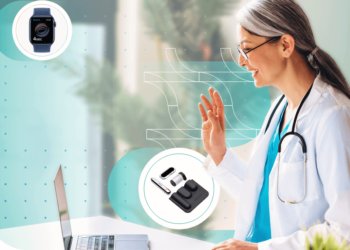
Wearable healthcare technology has grown in popularity over the last few years. With advancements in biosensor technology and accuracy, smaller battery sizes, and increased performance, wearable medical technology can provide users with accurate healthcare data that keeps them in charge of their own healthcare.

What is wearable healthcare technology?
Wearable healthcare technology refers to health monitoring devices worn on the body, such as the wrist, to help monitor the wearer’s health data. These devices use biosensors to collect different data from the patient, such as heart rate, blood pressure, sleep patterns, and activity.
Over the years, wearable medical devices have become increasingly popular due to the advancements in sensor technology and the ability to make sensors and batteries very small.
Wearable medical technology is used for various reasons and can accurately monitorfitness, heart rate, general wellness, and disease management. They can also provide medication reminders and store patient health information.
Why should you use wearable health monitoring devices?
Keeping track of your health is essential. Therefore, wearing a healthcare monitoring device can save time by automatically tracking your information. In addition, they are generally convenient and easy to use — some can even relay information to your healthcare practitioner on your behalf.
Most wearable healthcare technology can accurately measure heart rate, sleep patterns, and activity level and effectively store the data on a phone or smartwatch. However, although healthcare technology has come a long way, there are some things they cannot accurately measure, such as blood pressure. Although a smartwatch cannot currently monitor blood pressure, many devices connect to appropriate medical devices and upload the data from the device into a smartphone.
Your health is essential; therefore, your wearable medical technology device must provide the most accurate information. Seeking out the best in medical technology is vital to the overall performance of wearable medical devices.
What sensors are used in wearable healthcare technology?
Medical technology uses biosensors to take accurate health data measurements from the patient. These sensors use biological molecules like enzymes to detect or measure specific substances like glucose, cholesterol, drugs, or health data, such as heart rate, blood pressure, or breathing rate.
Biosensors detect biological, chemical, or physical signals and convert them into measurable electrical or optical signals.
There are two main types of biosensors used in wearable medical devices:
- Photodiode sensor. This type of sensor converts light energy into electrical energy. Similar to the strip on a solar-powered calculator, this sensor converts the data from a vein into usable data translated back to the wearable device to transmit information to the user. Although not known to be the most accurate sensor in a healthcare device, it’s a much less expensive option for manufacturers.
- Complementary metal–oxide–semiconductor (CMOS) sensors. The CMOS is known on the market for its accuracy and intelligence. Like a high-end DSLR camera lens, the CMOS sensor can accurately direct its focus and even cancel out other noises and light that may affect a reading. In addition, the CMOS sensor can also detect atrial fibrillation (Afib), a common heart condition.
Best health monitoring devices to use every day
Below is a curated list of the best products for different healthcare monitoring needs. Although smartwatches can do many things, no smartwatch on the market accurately monitors blood pressure readings. One study found that smartwatches failed to meet predefined accuracy guidelines set by Public Health guidelines when comparing data from a manual cuff to a smartwatch.
1. Blood pressure monitors
The Qardioarm Blood Pressure Monitor — this device is the best on the market and has over 2K 5-star reviews. The monitor is placed on the right or left arm and accurately provides the user with a blood pressure reading right to their phone. The at-home blood pressure cuff is still the most accurate device on the market, and the Quardioram Blood Pressure Monitor cuff can connect to a smartphone to store blood pressure and pulse data.

2. Glucose meters
The Freestyle Libre 2 — this advanced blood glucose reading device is known to be the best on the market for diabetic glucose monitoring. It offers a device placed on the upper arm and uses a phone sensor to measure the reading from the device. This device is ideal because it lessens the need for patients to “prick” their fingers, as the device can be used for up to seven days at a time.

3. ECG monitors
The Apple Watch — Apple technology is always ahead of the competition. The Apple Watch is the only wearable device to detect abnormal heart rhythms and accurately provide ECG readings. However, although the Apple Watch technology is advanced, it cannot detect heart attacks, blood clots, strokes, or other heart-related conditions, such as congestive heart failure.

4. Fitness trackers
Fitbit Charge 5 — This smartwatch is known to be one of the most accurate and easiest-to-navigate fitness trackers available. This sleek and compact design accurately monitors everything from heart rate to steps and has a battery life that lasts up to 7 days. Fitbit has changed its technology over time and has very accurate and updated software to monitor and store your health and fitness information accurately.

5. Integrated Activewear
NADI X Activewear — Innovative technology has now been integrated into activewear and is available in all different shapes and sizes. The NADI X has hundreds of 5-star reviews. The brand uses mild vibrations from sensors integrated into the clothing to tell the wearer if they are practicing yoga moves accurately. This can help overall balance and lead to achieving better fitness goals.

What is the future of wearable technology in healthcare?
The future of wearable technology in healthcare looks very promising. Using the most accurate sensors and technology, engineers can provide the user with the best and most precise healthcare monitoring. Wearable health technology has the potential to revolutionize healthcare by enabling patients to take a more proactive approach to their health and well-being. However, there is much more to come, and the future of healthcare technology is still in its early stages.
Many great wearable healthcare monitoring devices on the market allow users to measure healthcare data accurately. The Apple Watch is known to be the most advanced smartwatch on the market, but other brands are close behind. New and innovative technology, such as NADI X, is reaching new heights and allowing users to perfect their practices while monitoring their health. Wearable healthcare technology is in the beginning stages of development, and there are lots to come in the future for new and existing brands alike.
FAQ
What are three popular wearable devices?
There are different makes and models of wearable devices on the market today. The most popular wearable devices are the Apple Watch, Fitbit, and the Garmin smartwatch.
How do medical sensors work?
Medical sensors use biosensors, such as photodiode sensors and complementary metal–oxide–semiconductor (CMOS) sensors. These sensors convert light energy into electrical energy or use camera imaging like a DSLR camera to capture a picture of the vein. Both sensors are very accurate.
What are four examples of wearable biosensors?
Four examples of wearable biosensors are Continuous Glucose Monitoring (CGM) devices, Smartwatches, Fitness trackers, and Smart technology clothing. These products can help monitor the health and wellness of those who use them.
Key takeaways:
- Wearable healthcare technology is healthcare monitoring devices worn on the body to monitor healthcare data through the use of biosensors.
- Wearable healthcare technology accurately monitors pulse, fitness data, and sleep; however, some devices, such as smartwatches, cannot accurately monitor blood pressure.
- Biosensors are used in smartwatch technology. We have outlined two main types of biosensors: photodiode sensors and complementary metal oxide semiconductor (CMOS) sensors.
- There are numerous wearable healthcare technology products on the market, so we’ve outlined the leaders in each category.