
• ABOUT MAIC
  • JOINT MAIC TEAMS
  • CONTACT US
  • ABOUT MAIC
  • JOINT MAIC TEAMS
  • CONTACT US

MARKET

Companies Directory

ACADEMY

Communities & Courses

WORK

Jobs & Projects

MAGAZINE

News & Adverts

  • HEALTHCARE
    Healthcare Industry
    Healthcare Trends
    Healthcare Economics
    Healthcare Regulations
    Healthcare Innovations
    Medical Innovations
    Global Health
    Patient Stories
    Healthcare Ethics
    Public Health
    Modern Healthcare

    HEALTHCARE

    Healthcare development news reflecting advancements, challenges, and innovations in the healthcare services industry. 

    Contact us

    Publish articles & research papers in HEALTHCARE categories.

  • FACILITY
    Healthcare Design
    Sustainability
    Technological
    Financial
    Infrastructure
    Workforce
    Patient Experience
    Regulatory Updates
    Community Initiatives

    FACILITY

    Developments in healthcare facilities, reflecting efforts to enhance infrastructure, technology, patient experience, etc.,

    Contact us

    Publish articles & research papers in FACILITY categories.

  • TECHNOLOGY
    News and Events
    Information Technology
    Telemedicine
    Regulatory Compliance
    Medical Devices
    Healthcare Blockchain
    Artificial Intelligence
    Healthcare IoT
    Innovation and Startups
    Health Mobile Apps
    Wearable Technology
    Healthcare Interoperability
    Healthcare Robotics
    Healthcare Cybersecurity
    Personalized Medicine

    TECHNOLOGY

    Exploring the intersection of healthcare and technology, including electronic health records, wearable devices, and AI in healthcare.

    Contact us

    Publish articles & research papers in TECHNOLOGY categories.

  • MANAGEMENT
    Operations Management
    Performance Metrics
    Strategic Planning
    Financial Management
    Change Management
    Policy and Regulation
    Quality Improvement
    Ethics and Compliance
    Human Resources
    Information Technology
    Leadership Strategies
    Legal Issues and Risk
    Marketing and Branding
    News and Trends
    Population Health

    MANAGEMENT

    Discussing strategies for effective healthcare management, healthcare system optimization, and improving patient outcomes.

    Contact us

    Publish articles & research papers in MANAGEMENT categories.

  • EDUCATION
    Workforce Development
    Remote Learning
    Diversity and Inclusion
    Patient Education
    Innovations In Assessment
    Innovations In Training
    Legal Considerations
    Professional Development
    Continuing Education
    Global Initiatives
    Leadership Development
    Interdisciplinary Initiatives
    Residency Program
    Interdisciplinary Initiatives

    EDUCATION

    Providing insights into medical education programs, training opportunities, and innovations in medical curriculum.

    Contact us

    Publish articles & research papers in EDUCATION categories.

  • RESEARCH
    Access and Equity
    Analytics and Decision
    Cost and Value
    Delivery Models
    Facility Performance
    Payment and Reimbursement
    Policy and Reform
    Quality Improvement
    Research Methodologies
    Service Integration
    Utilization and Outcomes
    Workforce and Staffing
    Patient Experience
    Patient-Centered Design
    Population Health
    Sustainability
    Safety and Security
    Space Utilization
    Telemedicine Services
    Compliance & Accreditation

    RESEARCH

    SummariSing recent breakthroughs in medical research, ongoing clinical trials, and their potential impact on patient care.

    Contact us

    Publish articles & research papers in RESEARCH categories.

LOGIN / REGISTER
Home Healthcare Facility Sustainability

Sustainability in healthcare: the impact of the health sector on the environment

Majid by Majid
2 years ago
in Sustainability
Reading Time: 6 mins read
0 0
A A
0
Sustainability in healthcare: the impact of the health sector on the environment
0
SHARES
1
VIEWS
Share on FacebookShare on Twitter

From CT scans to anaesthesia, healthcare has a bigger carbon footprint than aviation. Will Cop28, with its aim to curb the sector’s global emissions, accelerate change?

A pledge to do no harm is often central to oaths taken by medical students on their way to becoming doctors. It’s a tenet that dates back to Hippocrates and the Ancient Greeks – but is it still being followed?

As the climate crisis intensifies and new information comes to light, it seems that the global healthcare industry, with its vast carbon footprint, needs to take action now to protect those it serves.

Climate change is described by a recent report in the Lancet medical journal as the biggest worldwide health threat of the 21st century. Growing rates of long-term illnesses are being triggered by air pollution and more communities find themselves living in disaster zones as a result of global warming.

The contribution of the world’s health systems is significant. In 2019, a now landmark report calculated that healthcare’s total carbon footprint is equivalent to 4.4% of global net greenhouse gas emissions, almost twice that of the aviation industry. To put this into perspective, if the healthcare sector were a country, it would be the fifth largest emitter on the planet.

Four years on, there is increasing international awareness among health and climate leaders. Cop28 recently released the first ever declaration to place health at the heart of climate action and accelerate the development of climate-resilient and sustainable health systems, with significant emissions reduction across the sector.

Multinational corporations are taking note too, with Philips Healthcare vocalising the need for sustainable change in healthcare through its newly launched Care Means the World platform, and also leading a number of initiatives.
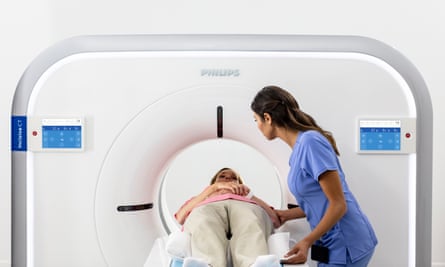
Philips Incisive CT in use with patient
Philips Incisive CT embeds AI within the system to improve precision, reducing the need for repeat scans. Photograph: Carl Fowler

“There’s a global momentum within the healthcare industry now,” says Robert Metzke, global head of sustainability at Philips, who attended Cop28. “A huge number of care providers are realising the need to tackle their impact on the environment. Whether it is using less energy and materials or producing less waste. Or adopting a circular approach by choosing products with eco design at their core and extending the lifetime of a piece of equipment.

“Our hospital customers tell us they want to commit to becoming carbon neutral, but healthcare is in the early stages of the journey, and many don’t know where to begin.” He suggests that conducting sustainability audits can often be an important starting point.

He adds: “Ultimately, it’s about moving away from a single-use mindset and embracing circularity. To make a lasting change, procuring with sustainability criteria in mind is critical. Only then can we look after the patient and the planet in equal measure.”

At a glance, healthcare might not seem an obvious contributor to emissions, but there are many energy-intensive aspects to it. These include the energy required to power and heat hospitals, and run the machinery within them.

Research also shows that around 25% of total healthcare emissions originate from energy consumed in manufacturing supply chains, such as those producing drugs and vaccines. But there are other less obvious sources too. NHS England’s annual carbon footprint has been placed at 25m tonnes, with contributing factors including gases such as nitrous oxide, used as anaesthetics, emissions relating to waste disposal, and patients using inhalers that rely on carbon-based propellants.

Hydrogen fuel Cell powered ambulance on display in the Blue Zone of COP26.

So how can we go about decarbonising healthcare while still ensuring patient safety, and without drastically increasing costs? A paper in the New England Journal of Medicine in April drew attention to the “cost myth” around reducing healthcare emissions.

The authors reported suggestions that initiatives such as installing solar power, waste reduction schemes and the long-term purchase of renewable energy could ultimately yield a positive return on investment, and would reduce greenhouse gases. In the medium term, this might mean more stable energy prices. In the long term, investing in climate solutions now would save money by reducing the need to treat patients for climate-related illnesses such as chronic lung diseases caused by air pollution.

There are plenty of other areas where improvements are possible. Research conducted by Philips Healthcare, in partnership with Vanderbilt University Medical Centre, in Nashville, investigated the carbon emissions of 13 diagnostic imaging devices, including MRI, CT, ultrasound and X-ray, which together account for about 12,000 patient scans a month. The research found that over a decade they emit as much CO2 as 1,000 petrol cars being driven for a year. The project suggested that implementing sustainable initiatives could help address this problem. Initial results indicated that rather than replacing imaging devices, upgrading or refurbishing them offered the twin benefits of reducing carbon emissions and the cost of ownership.

In future, AI may help hospitals to reduce emissions by, for example, accurately reading minute details on scans and identifying when repeats are unnecessary. Next generation devices such as Philips Incisive CT are more energy efficient than their predecessors and embed AI within the system to improve precision in the radiation dose and enhance image quality, reducing the need for repeat scans.

While cutting healthcare emissions will not be straightforward, a commitment to change seems to be emerging. At Cop28, the WHO director-general, Dr Tedros Adhanom Ghebreyesus, acknowledged the need to build low-carbon health systems, while NHS England has outlined a plan for reaching net zero by 2040 for emissions it controls directly, and 2045 for wider emissions. This will involve increasing the use of solar panels and ultra-low emission vehicles, including hydrogen-electric zero-emission ambulances. There are also plans to decommission desflurane – an anaesthetic with a global warming potential 2,500 times greater than that of CO2. The Greener NHS programme, meanwhile, is working with catering leads and suppliers to increase the provision of locally sourced food for patients and staff to cut transport-related emissions.

There are still significant challenges afoot, but positive signs are also emerging from the pharmaceutical industry. The Sustainable Markets Initiative Health Systems Task Force reports being in advanced discussions with energy providers in China and India to scale renewable power across many of the supply chains used to procure vital raw materials for medicines. The task force, a public-private partnership of CEOs and healthcare leaders, also says it has set minimum environmental targets for 100 of the world’s largest pharmaceutical suppliers. These targets, it adds, have the potential to address 3.5m tonnes of CO2 emissions each year.

The Cop28 UAE Climate and Health Declaration, signed by 123 countries, can be seen as a breakthrough in the fight to decrease healthcare emissions. The problem is urgent, but if healthcare professionals worldwide act quickly, globally, and collectively, it is one that can be addressed. Then the international healthcare industry can feel it is walking in the footsteps of Hippocrates – for the good of the planet and every person on it.


Get real time update about this post categories directly on your device, subscribe now.

Unsubscribe
Majid

Majid

Related Posts

Healthcare Sustainability
Healthcare Design

Healthcare Sustainability

March 1, 2024

Leave a Reply Cancel reply

Your email address will not be published. Required fields are marked *

Weather

Stay Connected test

  • 23.9k Followers
  • 99 Subscribers

Search

No Result
View All Result
  • Trending
  • Comments
  • Latest
17 top healthcare innovations 2023, identified by the global R&D community

17 top healthcare innovations 2023, identified by the global R&D community

March 1, 2024
Importance of Community Healthcare Initiatives

Importance of Community Healthcare Initiatives

March 13, 2024
Healthcare Operations Management: Everything You Need to Know

Healthcare Operations Management: Everything You Need to Know

March 13, 2024
Healthcare Economics: Key Features of Healthcare Markets

Healthcare Economics: Key Features of Healthcare Markets

March 1, 2024
Three steps healthcare organisations can take to use generative AI responsibly

Three steps healthcare organisations can take to use generative AI responsibly

0
Are medical imaging technologies being used to their fullest capacity or are these being overused?

Are medical imaging technologies being used to their fullest capacity or are these being overused?

0
Integrating Smart Hospital Solutions into Health IT Ecosystems

Integrating Smart Hospital Solutions into Health IT Ecosystems

0
Focusing on the Outcomes of Strong Zero-Trust Architecture in Healthcare

Focusing on the Outcomes of Strong Zero-Trust Architecture in Healthcare

0
8 Examples Of Quality Improvement Initiatives In Healthcare & Hospitals

8 Examples Of Quality Improvement Initiatives In Healthcare & Hospitals

March 13, 2024
What is Quality Improvement in Healthcare?

What is Quality Improvement in Healthcare?

March 13, 2024
Importance of Community Healthcare Initiatives

Importance of Community Healthcare Initiatives

March 13, 2024
Legislation updates for private health service establishments

Legislation updates for private health service establishments

March 13, 2024

Recent News

8 Examples Of Quality Improvement Initiatives In Healthcare & Hospitals

8 Examples Of Quality Improvement Initiatives In Healthcare & Hospitals

March 13, 2024
What is Quality Improvement in Healthcare?

What is Quality Improvement in Healthcare?

March 13, 2024
Importance of Community Healthcare Initiatives

Importance of Community Healthcare Initiatives

March 13, 2024
Legislation updates for private health service establishments

Legislation updates for private health service establishments

March 13, 2024

Follow MAIC

  • United Kingdom - Solihull
  • (+44) 0208-1236117
  • Saudia Arabia - Riyadh
  • (+966) 059-1248787
  • 9 am - 7 pm
  • support@maic.center

SUPPORT

  • FAQ
  • Help Center
  • Terms of Service
  • Privacy Policy
  • Pricing
  • FAQ
  • Help Center
  • Terms of Service
  • Privacy Policy
  • Pricing

Download apps

  • iOS App
  • Android App

Follow Us

Pinterest-square Twitter Youtube Linkedin

NEWSLETTER

Stay up to date with our latest news, receive & deals.

MAIC @2024 Medical Architecture InterComunity

Add New Playlist

No Result
View All Result

© 2026 JNews - Premium WordPress news & magazine theme by Jegtheme.

Are you sure want to unlock this post?
Unlock left : 0
Are you sure want to cancel subscription?