What is a budget in healthcare?
A healthcare or hospital budget is an estimation of revenue and expenses over a specified timeframe. Through the healthcare budgeting process, health systems come to an understanding of how much funding must be planned in certain areas, including operating costs and capital equipment. A health system may include hospitals, physician groups, skilled nursing facilities, home care services, foundations, and a variety of other business types. During the budgeting process, leaders must account for key components of planning in healthcare, including volume growth assumptions, feedback and input from key stakeholders, and the ability to adjust when inputs and circumstances change. Ultimately, a well-planned budget allows health systems to plan appropriately for the future in order to provide quality care.

What are the types of budgeting in healthcare organizations?
There are several types of budgets and planning processes in healthcare:
- Operational budgeting in healthcare is the process of determining the funding planned for facility operating costs and personnel costs, such as staffing and training. Staffing is usually the largest cost in a healthcare operational budget, and it must not only account for fixed costs, like salaries, but overtime hours, potential overstaffing, and other variable costs. A healthcare operational budget allows hospitals and health systems to monitor and balance revenues and expenses.
- Capital budgeting in healthcare is the process of allocating funding to the purchase of durable goods, such as beds, equipment, or improvements to buildings or infrastructure. A hospital capital budget is important because the purchases made from this pool of resources (e.g., more surgical equipment or updated technology) can have a direct impact on a health system’s ability to provide better care to more patients. Capital budgeting in healthcare is generally related to the hospital or health system’s overall strategic vision for the organization.
When comparing an operating budget to a capital budget, it’s important to note that while the two are separate, each influences the other. Capital investments, such as new facilities or updated technology, can impact future staffing and operating costs. Funding for those purchases, however, may need to come from the operating budget. When planning hospital budgets, leaders must balance the effects of the two budgets. - Rolling forecasting in healthcare is a process for healthcare leaders to update their financial projections on a monthly or quarterly basis. This process uses historical data to continuously update near- and long-term projections. With frequent updates, leaders can adjust their strategy as conditions change. By utilizing rolling forecasting, healthcare organizations can plan more efficiently and make agile, data-driven decisions.
Why is budgeting important in healthcare?
Healthcare is a rapidly changing industry that must continuously adapt as new patient needs emerge, technologies and techniques are updated, and reimbursement models evolve. A strong healthcare budgeting process allows leaders to plan for the future and establish priorities around care and clinical departments. A healthcare budget is an important tool to understand where funds are best spent and how to allocate capital among various departments and projects. This enables healthcare organizations to be more efficient in delivering effective and efficient patient care.
What are the benefits of budgeting in healthcare?
Healthcare budgeting is critical for decision-making across health systems and organizations. An effective budget process allows healthcare leaders to:
- Align operational plans with financial planning targets
- Prioritize capital investments to align with strategic initiatives
- Effectively manage capital spend and cash flow
- Better understand the allotment of funding to individual projects, initiatives, and clinical departments
- Minimize purchasing errors
What budget-related challenges do hospitals face?
Because of the rapidly changing nature of the healthcare industry, health systems and hospitals face many budget-related challenges, including:
- Unpredictable economic events, such as the 2020 COVID-19 pandemic, which can render static budgets outdated and inaccurate
- Changes to reimbursement and payment models, including declines in Medicare and Medicaid reimbursement
- Development and adoption of new technologies, such as telehealth and home-based medicine
- Labor shortages and increasing costs
- Mergers, acquisitions, and increasing market competition from new care delivery models
- Supply chain issues and interruptions, such as personal protective equipment (PPE) or prescription drug shortages
What factors affect a healthcare budget?
Beyond factors within a health system’s control, a variety of external factors can affect a healthcare budget, including:
- Changes in patient volumes across various departments, which can affect service line budgeting
- Rising interest rates
- Inflation
- Higher capital acquisition costs
The budgeting process in healthcare
The process of healthcare budgeting differs based on your planning approach, be it traditional budgeting or rolling forecasting.
Traditional budget
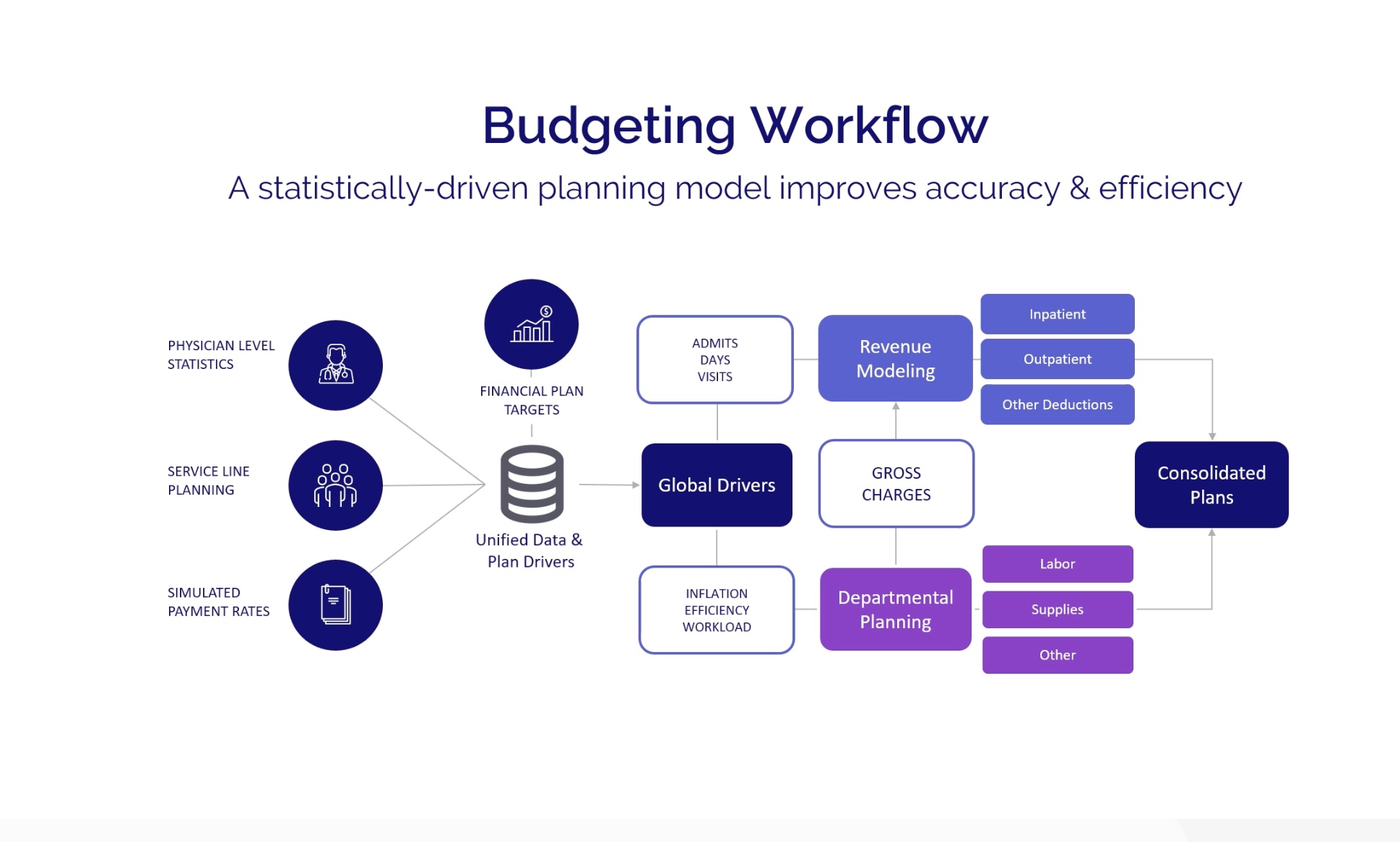
The traditional healthcare budgeting process typically involves budgeting software that incorporates historical data, inputs, and assumptions. Healthcare leadership reviews relevant data in the system from across all clinical services and departments.
The budget is then routed for input, updates, and approval from a variety of stakeholders. Ultimately, this process results in a budget that applies to a static period of time (such as a calendar year, Jan. 1 through Dec. 31).
Rolling forecasting
Rolling forecasting is a planning approach that allows healthcare leaders the flexibility to use historical data to predict future performance. Essentially, it answers the question, “How has the previous month or quarter changed our view of the present and future?”.
Unlike a traditional budget, which is based on static, annual data, rolling forecasts use current data to update near- and long-term projections. Based on rolling forecasts, leaders can quickly adjust strategy as financial conditions change, examine current expenditures and initiatives, and make strategic decisions about future endeavors.
Here’s how the process generally works:
- Budget process participants come together each month or quarter to assess and update the organization’s financial performance
- Participants select the appropriate forecast horizon (e.g., monthly or quarterly periodic forecasts for the current year and up to two years forward)
- Using the most recent data available, comparative and trend analyses are performed, often taking multiple scenarios into account. For example, to analyze the forecast for sensitivity and risk, organizations typically test against at least three sets of conditions, with favorable, unfavorable, and very unfavorable outlooks
- Based on these analyses, leaders evaluate key actions their organization should take now and in the short- and long-term to strengthen and protect the organization’s performance
With this process, leaders can create forecasts for six to 12 quarters, rather than only 12 months.
Best practices for the healthcare budgeting process
To avoid common budgeting struggles, healthcare organizations can simplify the planning process with these tips:
- Create a budget calendar that shows the major tasks that need to be addressed during the process, who’s responsible, and major deadlines
- Set realistic deadlines
- Strive for continual improvement, documenting insights and enhancements that can be applied during the next planning cycle
- Develop a timely monthly variance analysis process
- Keep reporting simple for new users, first offering a smaller set of basic reports, and then providing more offerings as your leaders’ comfort levels increase
- Give experienced users deeper insights, such as reports for individual departments on total revenue, operating income, expenses, salaries, and supplies, on both a current month and year-to-date basis
- If you have an automated planning solution, keep it updated to ensure access to the latest features, enhancements, and dashboards