
What is interoperability in healthcare?
Interoperability in healthcare refers to timely and secure access, integration and use of electronic health data so that it can be used to optimize health outcomes for individuals and populations.
Why healthcare interoperability important?
Health data has always been challenging to access and share in a secure manner. The nature of health data creates a paradox: It’s difficult to share because it’s sensitive and requires a high level of privacy and security, yet the inability to access it when it’s needed has potential to cause significant harm. A lack of interoperability can result in an incomplete understanding of an individual’s or population’s health needs, which can lead to poorer outcomes and higher costs.
As populations around the world age and people live longer, interoperability and data sharing are going to become increasingly critical for delivering effective healthcare. In the United States, the Agency for Healthcare Research and Quality has estimated that two out of three older Americans have at least two chronic behavioral or physical conditions. Treatment for people with multiple chronic conditions currently accounts for an estimated 66% of US healthcare costs.
In their nationwide roadmap, the Office of the National Coordinator for Health Information Technology (ONC) says the use of electronic health records (EHRs) has dramatically increased in the United States. Many hospitals now have routine access to medical records and patient data from outside providers, yet less than half of hospitals are integrating the data they receive into individual patient records. So although access to vital clinical data has improved, there’s still a lot of work that needs to be done to bring stakeholders together to create an integrated data ecosystem.
In addition to helping physicians and other healthcare providers see a more complete view of their patients, health data interoperability helps organizations across the healthcare industry. If health information systems were more integrated, then health plans would be able to develop a better understanding of their utilization rates and demand for services. Government service providers would be able to access population data to see trends and meet their citizens’ needs. Also, life science organizations would be able to leverage robust datasets to drive faster, more informed research.
With better interoperability, organizations would be able to stop regarding individuals as a patient one day, a health plan member the next and a consumer of health apps the next. Instead, decision-makers across the industry would be able start looking at how people access and use health information, regardless of its source, to drive better models of care, pursue better patient safety and improve experiences for the people they serve.
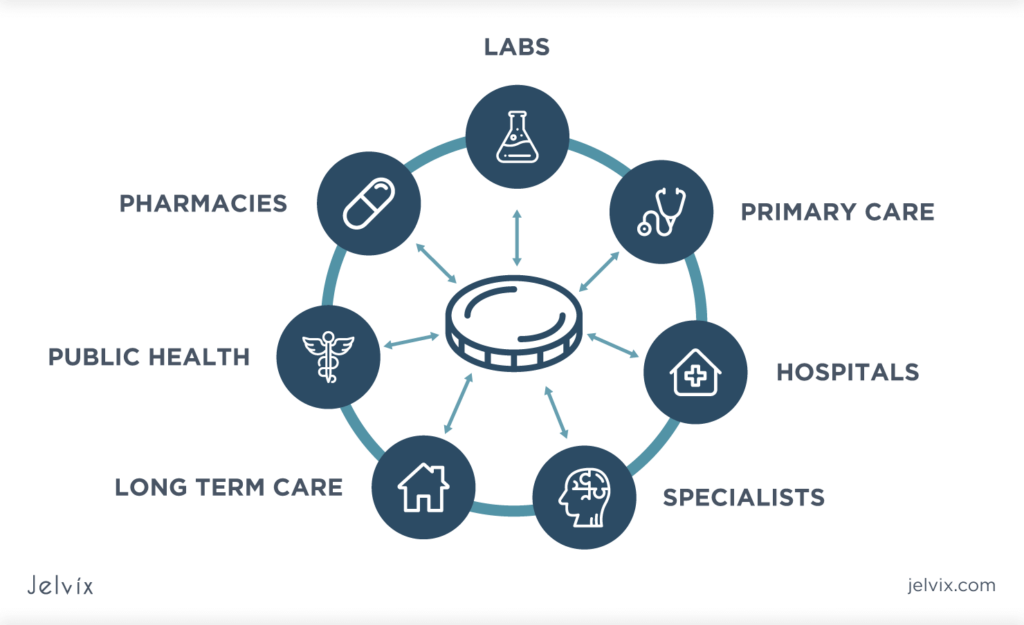
Healthcare interoperability benefits
Better care coordination
With access to data, clinicians have an easier time accessing a patient’s most important health information, which can lead to fewer repeat tests, prevent inadvertent treatment interactions and reduce miscommunications.
Higher performance
When data can be combined more easily, it can also be analyzed more easily. Interoperability makes it possible for organizations to study data trends, past performance and make data-driven improvements in patient care and other areas.
Better experiences
Data interoperability can reduce the amount of redundant administrative work both within and outside organizations, creating a more satisfying experiences both for employees and for those they serve.What is FHIR?
Fast Healthcare Interoperability Resources, also known as FHIR, is an open source standards framework for healthcare data that builds off of a previous standards framework called HL7. FHIR was created to make it easier for healthcare data to move from one system to another.
FHIR organizes data into resources like patient, conditions, medications and provides a standardized structure for how that data is organized and interpreted by different computer systems or applications. FHIR can also be used to structure financial data and workflow data, such as claims information, appointments and more.
Many major healthcare systems in United States have already adopted FHIR in their health IT practices. Medicare’s Blue Button 2.0 initiative is based on FHIR and the Veteran’s Affairs Administration has developed a FHIR platform called Lighthouse. Both provide platforms for patient access to healthcare information through FHIR.
The National Coordinator for Health IT in the United States has made FHIR a key part of the nationwide interoperability roadmap. New government regulations and interoperability rules are requiring wider adoption of FHIR, so it’s vital for healthcare organizations, especially for ones that receive payments for Medicare or Medicaid services, to understand FHIR and incorporate it into their interoperability strategies.Health information exchanges and interoperability
Modern consumers have high expectations when it comes to accessing information, and many now expect to have quick and continuous access to records about their health and care. That’s why many healthcare organizations are building health information exchanges (HIE), which are specialized networks that rely on interoperable systems to share electronic health information seamlessly and securely.
Even though the adoption of EHRs was a good first step towards building HIEs, there are still many challenges that need to be overcome to achieve the level of interoperability needed to obtain the full benefits of HIEs. These challenges include:
Lack of standardization: Although standard record formats like FHIR and HL7 are becoming more common and new regulations are pushing EHR vendors to provide APIs that support interoperability, many providers and healthcare systems use customized EHR systems that can be hard to convert to a standard format and shared with others.
Security: Healthcare organizations can find it hard to balance the need for health information to be accessible with the need to secure sensitive information and maintain patient privacy, especially with the increasing number of cybersecurity attacks on healthcare systems.
Consent: By building digital health systems in which health information flows freely from provider to provider, it’s not always clear when patient consent is needed and what level of consent is needed. Healthcare organizations are understandably cautious about this and tend to error on the side of not sharing information.
Professional burdens: When new tools for recordkeeping are introduced, people need to learn how to use them. Healthcare professionals are often wary about new systems since EHR systems often do a better job supporting administrative and billing workflows than clinicians’ needs.
These challenges are not insurmountable. With advances in cloud computing, especially hybrid cloud, it’s become easier for organizations to move and secure data in a consistent way. Cloud environments provide opportunities for organizations to build data pipelines that standardize data to an industry-standard format like FHIR and provide secure access to people who need it – whether they’re payers, providers or patients themselves. CMS efforts to promote interoperability
In 2016, President Obama took a major step to solve information blocking by signing the 21st Century Cures Act, which requires EHR systems to provide a patient-facing API to maintain their federal certification. In 2020, the Centers for Medicaid & Medicare Services (CMS) issued a rule requiring health plans and providers who receive federal funds from their programs must take steps to make health information easier to access.
Most of the policies focus on encouraging payers to implement application programming interfaces (APIs) and data exchanges that provide secure access to their provider directories, patient claims data and other resources that would make it easier for data to be accessed in a timely manner. This access would give patients, as well as providers and payers, a more holistic view of the care people receive and support broader public health efforts.
Prepare for interoperability.
See how mandatory interoperability standards will affect your organization.
The challenges of interoperability in healthcare
While many healthcare experts and leaders agree that better interoperability would improve healthcare overall, there are common challenges that healthcare organizations tend to face as they work on making their data and systems more interoperable. Let’s explore those challenges and how organizations can overcome them:
Disjointed coordination
Improving interoperability requires strong coordination between different organizations, regulators and leaders as well as coordination within organizations. Regulators provide standards and rules for healthcare organizations to follow but organizations that want to be proactive about interoperability should consider creating a dedicated interoperability strategy and make interoperability planning a priority.
Limited budgets
Not all organizations have the financial or technical resources they need to invest in the technical resources needed to build a truly interoperable system. There may be some government grants available to update health records systems, so organizations should check to see if they’re eligible. Many cloud vendors also offer pay-as-you-go payment models that could make technical expenses more affordable and predictable.
Diverse technology needs
Organizations need to follow different rules and regulations depending on what type of care they provide and where they’re located, so many organizations have highly customized data. Organizations can help connect different internal and external systems through a hybrid cloud platform that gives them options to combine and integrate their data without sacrificing the customizations they need.
Legacy systems
Healthcare organizations with older legacy systems face the dual challenges of modernizing their systems while also meeting interoperability requirements. Organizations can meet both goals using a hybrid cloud approach to extract data from legacy systems and make it more accessible for modern applications and programs. This approach gives organizations the option to keep data moving while they work on updating their systems.Levels of healthcare interoperability
Interoperability for healthcare has four different levels that have been defined by informatics experts and the Healthcare Information and Management Systems Society (HIMSS). Some of these levels can be achieved today with existing healthcare IT architecture and IT systems, while others will require innovation and additional developments in patient-centered technology.
These levels include:
Foundational
This level of interoperability, also known as simple transport, is the most basic. Data is securely transferred from one system or device to another without interpreting the data or transforming it into a particular format. For example, a nurse downloads a PDF file of a patient’s latest lab results from the lab’s results portal, then manually enters the data into the patient’s health record.

Structural
When structural interoperability, or structured transport, is achieved, all the data is standardized to a particular format so it can be interpreted by multiple systems or devices. This data is organized in a particular order so the receiving system can automatically detect specific data fields. Data standards like FHIR and HL7 provide structural interoperability so records can be consistent, centralized and easy to move between systems.
Semantic
The semantic level of interoperability, or semantic transport, involves exchanging data between systems with completely different data structures. Imaging systems provide a simple example — there are many specialized DICOM and non-DICOM formats for images. With semantic interoperability, images could be transferred from one system to another, interpreted and incorporated into the new system regardless of the image’s original format or source. Yet determining what data to collect and transfer can be difficult, since systems have different ways of presenting the same information. For that reason, some experts argue artificial intelligence will be needed to achieve full semantic interoperability.

Organizational
Organizational interoperability involves the seamless exchange of data between various organizations with different requirements, regulations and goals. To achieve this level of interoperability, there must be policy and governance innovations as well as technological innovations to ensure consent, security and integrated workflows move smoothly between different groups. Though some experts say semantic is the highest level of interoperability, others say it is organizational interoperability.

Related Solutions